Search This Blog

Showing posts with label 73 Cents. Show all posts

Friday, May 4, 2012

Rally with Us in Support of Patient Data Access May 6th!

The AHA (American Hospital Association) is hosting their annual meeting on Sunday, May 6th at The Washington Hilton 1919 Connecticut Ave.  Washington, DC.

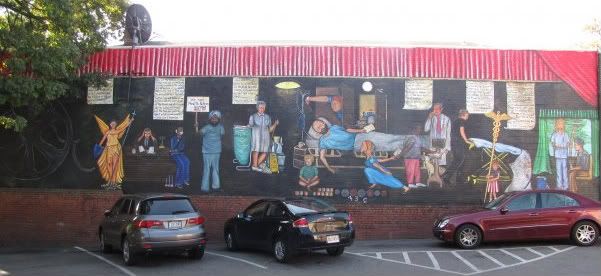
They will meet right down the street from where I live, where my children live and where my husband died.  They will meet at a hotel that is on the same street as the mural 73 Cents.  That painting is a testament to the need for data access and I painted it in the 3 months immediately following my husband’s death.

The AHA meeting will take place mere feet away from the offices of the National Partnership for Women and Families.   On Wednesday, Christine Bechtel Vice President of @NPWF wrote a post entitled, “Don’t let them destroy patient protections in health IT!”  Her post objected to the hostile stance of the AHA towards patients’ data access. 

The AHA would like patients to wait 30 days to see their medical records after an episode of care.  This stance is in direct opposition to the hard work of many doctors, patients and members of the Department of Health and Human Services.

I humbly invite all of you to meet me on the sidewalks surrounding The Washington Hilton on Sunday May 6th .   We will gather from 2-6 in the afternoon.  Wear your Walking Gallery jackets and be prepared to wave them or to wear them.  Make signs supporting patient access to the medical record or use the ones I make with the help of children and friends.  Come in your Sunday best or your weekend casual wear.  Bring your entire family.  Let your children join my little Isaac in his joyous shout, “Healthcare! Healthcare!”

I will bring bubbles and we shall walk and blow them in the air.  Let us be joyous and each bubble will represent the over-blown egos of association that would dare to deny us access to our own information.

For a moment in time those bubbles will glisten with beauty and appear to be a seamless whole entity… and then shall pop.

Be brave for I know many of you work in healthcare and taking on the AHA can be scary.  But take inspiration from the statue in front of this grand hotel.  It is a statue of General George B. McClellan.  My wonderful husband Fred, who was a civil war buff, detested McClellan.  McClellan constantly over estimated the strength of the opposing army and his tactics were unsuited for the battlefield.  He almost lost the war for the Union.  He was a bureaucratic leader not the man for timely decisions about life and death.

It seems that statue is a fitting symbol for the AHA stance today.

The statue in Front of the Washington Hilton

Saturday, April 30, 2011

The Walking Gallery

We are the Gallery that walks.  We are the Patients that wear our stories on our backs.  Soon we we shall to come to a city near you and and create gallery space in moments.  We won’t pound a single nail into the walls to hold the art.  Dozens of people will walk into a space wearing business jackets or doctor’s lab coats.  That alone is not unusual.  But these jackets will be works of art.  Each one shall be painted with the story of a patient or an element of medical advocacy by me or another artist.  These masterpieces will be worn on the backs of government employees, technology gurus, medical professionals, social media activists, CEO’s of companies and artists.  It shall be a great meeting of the minds.

The Walking Gallery exists because Jen McCabe followed me on Twitter on May 30th 2009.    That was the day before I placed the Medical Facts Mural in Pumpernickels Deli on Connecticut Ave.  That was a day when my Fred was still alive and could speak and eat again because of the wonderful care he was receiving in Washington Home Hospice.  Jen was one of my first followers on Twitter and is such a glorious spark of life.  

On August 20th she emailed me after I had posted a comment on her blog and asked me if I would paint a series of paintings on the back of her blazers to wear to upcoming health meetings.  I told her I would be honored to paint jackets for her.  Jen responded, “Symbols and talismans mean quite a bit to me, and having things constructed by friends is one way to remind myself why I do the work I do and forego so many of the other things I enjoy.  I'm so happy to have a wearable badge of courage - just wrote an index card for myself to remind me of the importance of patient advocacy by "any means necessary."  Art is another one of those means.”

I finished the second mural “73 Cents” on September 30th 2009.  It was my feverish obsession in the weeks after Fred’s death.  “73 Cents” was a thing that I had to do.  It soothed my soul; it spoke to me and calmed my aching heart.  It gave me a reason to leave the solitary confines of my mind and my widowhood.  It gave me permission to stand on the street and talk with complete strangers about the grief roaring within me.  I often go to social justice events and hear about the chronically homeless on the street.  I hear workers complain that they find small single apartments for these folks to live in, but instead many return to the street. 

I think I know the reason why. 

It is hard to be alone when sadness is engulfing the mind.  The street is alive, and there the broken congregate and help each other.  Each day I painted I made many new friends, but those who came back and spoke to eye to eye were often the most dispossessed and the homeless. 

Without Jen’s suggestion that I paint jackets, I would have gone home, my Magnum Opus done, to loneliness and grief.  Yes, I was still blogging, but that was not enough.  I had to paint.  I had to spread the word through art.  Jen had provided a new “wall,” and that wall could walk into the Mayo clinic or the National Board of Medical Examiners and remind everyone of those patients who suffer in a system without real time data access.
IMG_9456
I would paint and post images of three jackets for Jen:  ”Data Prison” on October 5th 2009,
Twitter on the Titanic photographed by Ted
“Titanic” on December 14th 2009
Tough Girl Advocate
“First Responder” on January 12th 2010.

As Jen and I began to tweet about the jackets, Elizabeth Cohen from Empowered Patient on CNN would see our twitter stream.  She said she would write a piece about the jackets on CNN health as they captured the zeitgeist of the patient data access movement that @ePatientDave had so apply entitled: “Give Us Our Damned Data.” 

caregivers clock

Due to Jen’s very public appearances wearing patient advocacy jackets, two other thought leaders would contact me to obtain images they too could wear.  Chiara Bell from Enurgi, later to become part of Univita Health, would ask to have a jacket of her own.  She wanted to show the importance of the caregiver in patient care.  I made for her the “Caregiver’s Clock” a painting that depicts both the family member as caregiver and the professional caregiver caring soothing the terminal patient.

Roni in his jacket

Finally, Roni  Zeiger from Google Health would contact me.  He wanted a jacket that depicted the passionate need for data access felt by the patient/caregiver.  I painted for him “Data Cloud” that recreated my desperate feelings to find out the truth via the Internet.  Roni Zeiger then wore that jacket at the Community Health Data Initiative event on June 3rd 2010 before a crowd of hundreds including Secretary of HHS Kathleen Sebelius.  Roni would finish his presentation about the Combining of HHS Hospital Compare with Google’s Fusion Tables Cloud Database App, by turning his back on the audience and saying, “The last thing I would like to mention is that, let’s not forget all of these data points tie back to individual people and their stories.  And many of you probably know of the work of Regina Holliday.  She is an incredible woman I met recently.  An artist. She made- I am not a fashion guy, but she made this jacket for me.  Feel free to come up after to get a closer look.  We made a deal.  She would make this jacket for me, if I would wear it at important conferences.   This is the first time I am wearing it.   And it is about the importance of data and the importance of talking about data and the importance of technology in the future if health care.”

Chiara and Regina

So, that is the story of five jackets that I painted to spread awareness.  Five jackets. They bring the “patient” into the room and onto the panel, when no patient was invited to attend.  They remind me of the encaustic mummy paintings from 1st century CE found in Egypt.  These amazingly real and poignant faces stare out above dried sinew, wrappings and bone.  Their eyes sear our souls and remind us, I was once one of you who lived and played, who laughed and loved before I met this fate.   They transcend the dust and the darkness of the ages, and make the lives lost long ago so very real.  The jackets worn by these brave few do the same for data, and pie charts and graphs. 

When you sit in an audience listening to a power point presentation, and the faces on these jackets stare back at you; it changes things.  It adds an edgy sense reality to dry recitation of data.  It wakes you up.

Perhaps you will have the honor to wear one of these creations.  It can be quite unsettling.  People will stop and stare.  You can now enter a conference and feel like an outsider.  Ostracized.  You can be given the gift of experiencing the disconnected feelings of the ignored patient in the room.   People will point and talk about your back like you are not even there.  You are a “case,” an object, you exist to be described and critiqued.   And after being at a conference all day, you can take that jacket off, and be normal again.  Or not.  You can “come out.”  You can let go of that other title, be it, Techie, Doctor, CEO or founder of a non-profit.  You can cease to be defined as the cog you appear to be in the machine called medicine.   You can be simply patient.  You can tell your personal story and reach your inner center as a patient.

Perhaps my painting will help you.  Perhaps it will be the icebreaker you need to let go of the ubiquitous black suit that blends in at a medical conference.  Perhaps it will be way to open up about why we are doing all of this important work.  We are doing this to help patients heal.  We are doing this so we can all live happier lives.

So… CALLING ALL JACKETS!  CALLING All ARTISTS! I need your jackets, I need your stories.  I need other artists who would like to join a movement.  Never let anyone tell you, that you do not have a voice.  Step up and Speak out.  We get great change by doing great things.    You will be surrounded and loved by others just like you.  It shall be a great fellowship of those deeply invested in patient empowerment.    

And then you shall go forth and wear your jacket at other conferences spreading the word about the importance of patient data access and truly patient centered care.  And sometimes you will be the only “patient” in the room.

But you will be brave and you will be proud, for you are a member of The Walking Gallery.
  

Monday, November 15, 2010

Thoughts Induced by Chewing Ice

IMG_6030

In the summer of 1976, I was four years old. This was the summer Americans were told to go on the road and rediscover America. Our family followed the national advice and began a road trip that would take us from Oklahoma to Kansas, Missouri, Nebraska, Colorado and New Mexico. It was a magical time. We piled into our brand new ’76 Chevy Impala and tasted the freedom of the road. Even though I was only four at the time, two experiences were seared within my mind during those kodachrome brilliant hot summer days.

While in Colorado we visited an amazing amusement park called Santa’s Workshop. Ten miles west of Colorado Springs, they have North Pole experience complete with a Candy Cane slide and the tallest Ferris wheel in the world. I will never forget the moment I rode that wheel. My family peered up at the huge ferris wheel that was built upon a mountain at a 7,500-foot altitude. The wheel operator dared us to ride the enormous structure. My mother chuckled and said she would not, my father laughed as well. I stepped forward. I said I would like to ride. The carny asked if I was sure. Did I really want to ride all by myself? I nodded yes, and was lifted up into the seat. The carny man pulled down the restraining bar that floated eight inches above my legs. I looked around to see, and found I was one of very few people who had attempted the ride. As my seat rose ever higher, my knuckles whitened around the restraining bar. I realized how easily I could fall. I looked at the great space between my legs and the bar and stared at my little fingers pressed so tightly on the cool metal. I looked down at my scuffed canvas shoes as they dangled so many feet above the crowds. As I reached the pinnacle of the ascent, I looked down so far below at my small family. At that moment, I felt so proud, so strong; I alone had braved the ride. I was filled with fear but I would not let it panic or conquer me. I was so glad that I got to do this. I cherished the moment and the trust my parents had in me, that even though I was only four, I could be brave. I was joyous and I was on top of the world.

Hills

That was an empowering experience. I floated bravely above for a few moments, but most of life is lived upon the ground. It is just as important to find empowering events within one’s daily life. So my other amazing experience of the summer of 1976 would be considered a boring reality to many, but I still remember and cherish the opportunity to get ice from the motel ice machine. To this day I cannot pass a hotel ice machine without smiling. Have you ever noticed as an adult you must crouch down slightly to get ice from these machines? I have often thought they were designed with a child’s height in mind. When I was four, many privileges and responsiblties were literally out-of-reach. I could not reach the sink to wash dishes or get a drink. I could not reach the dishes in the cabinets to set the table. But as we stayed in hotels, I began to relish my new duty of getting ice. I would take the ice bucket and would run down the hall to the ice machine. I would listen to its calming motor hum, as I would place the bucket on the lever. The rattling clunks would echo inside the machine, as the motor would gear up. The hole above the lever would begin to spew the mounds of ice into the bucket. Hotel after hotel, I would do this ritual and I discovered there were many types of ice. In some motels it would come out as cubes, sometimes it would be frozen rounded discs and sometimes wedge shaped smiles. By far, my favorite ice was the donut type. This ice would cascade out in circles. My sister, my brother and I would eat this ice like it was popcorn. I loved the way it would roll within my mouth. I loved the delightful chill of slipping my tongue inside the hole within the ice. I would press my tongue until eventually the ice would turn thin and sharp, and then I would crunch my teeth upon the shards. I loved chewing ice, but even more I loved the ability to get that ice myself.


So the child I was became the wife that stood in front of other ice machines. Pastel pitchers had replaced the old plastic bucket. I had lived much in the 33 years between hotel ice machines and hospital ice machines. I had married, given birth, managed stores and was well acquainted with both responsibility and privilege. So as I begged for access to information and asked how I could help my husband, I was handed a plastic pitcher and given the one duty I could be trusted with. I could get him ice water. Each day, many times a day, I would get Fred ice. I would leave the room and carry that little pitcher down the hall and fill it up again and again. I grew concerned as time past that the facilities did not replace nor clean the pitcher.

Hospital Ice

In the first hospital we had the same pitcher for two weeks before it crashed upon the floor and shattered. It was then replaced. Fred went for another two weeks with his second pitcher. It was a mauve pink pitcher and I took it home upon discharge. (It became my water bucket while painting 73 Cents.) At the second facility, Fred again was given a plastic pitcher. After a week of using it, I came to the hospital one morning to find a black substance inside the bottom of the pitcher. I showed it to the nursing supervisor, she alerted other floors about the potential for patient harm. While Fred was hospitalized, we saw that facility take steps to discontinue use of the re-useable, yet never washed, plastic pitcher.


So as Fred grew more ill, I often thought of ice and ice machines. The first thing I would do each day was to get him ice. The last task before leaving his room was to check and see if his pitcher was still filled. It made me sad. Sometimes I too, would drink the water and chew the ice. I would think of the ice I sucked upon while I labored before the birth of our two sons. I would think of the happy anxious father who would eagerly go down the hall to get me ice chips. He was so nervous he practically bounded down the hall. I chucked through the pain of childbirth, upon seeing his behavior, but at least that duty made him feel useful.


Those are thoughts induced by chewing ice. Eventually thoughts like these grew into a blog. Eventually they were shared with anyone who would like to see them. On December 12th I wrote of ice. I wrote about the ice that chewed the bowels of a very important ship. I wrote about what medicine can learn from events within our past and the importance of wireless technology on the Titanic. The blog was called: Social Media on the Titanic: RT @Titanic #ICE BURG ahead :(

Because of that post I met an amazing man known as the Ice Chewer on Blogger and Twitter. He posted this comment:

I feel grateful that you are writing this blog. Our inefficient health care system manages to stay this way because patients and families, at the moment when they are most vulnerable, have to spend their emotional resources dealing with unilateral and arbitrary decisions of hospital administrators, insurance companies, and doctors. And that is how we lose our energies to fight for change. But seeing that you and others who went through a terrible experience are not giving up, gives us all some hope and inspiration to fight. Thank you!

By the ice chewer on Social Media on the Titanic: RT @Titanic #ICE BURG... on 12/12/09

12/12/09 http://icechewer.blogspot.com/

That is how I met Yuval Sheer. He lives in New York and writes a wonderful blog that reflects upon life and art and, of course, chewing ice. In the classic sense of knowing someone by meeting him in person, I suppose we have yet to meet. I feel as though I know ice chewer through his quirky writing, interesting photos and the amazing artistic interpretations of created by his dear Mettookonet.

"Thoughts Induced by Chewing Ice"

The ice chewer has posted comments on my blog 10 times and we also touch base on Twitter. In July, I was honored to receive a precious copy of his limited edition book: “Thoughts Induced by Chewing Ice.” It is filled with many posts of wisdom and makes me wish I could be far wittier than I am. The ice chewer writes with wit and humor as he chews on cold ice. I blog of pop culture, health and my family with deep emotion and often hot tears. We both use photos and art frequently to make points within our posts. My favorite page in the book "Thoughts Induced by Chewing Ice

My favorite page within his book depicts an artist painting an I-phone at an easel. This page was based on a post from November 5th, 2009. The text of the post was as follows; “I took a photo with my cell of a man hanging his photography work on a wall at the subway station. He got angry and told me: "good luck with your non-creative life”. So I got creative, and blogged about it.” -posthttp://icechewer.blogspot.com/2009/11/good-luck.html


I love this statement. It is not enough to only paint. There are many types of artists and art, just as there are many types of ice. It is the thoughts induced by chewing ice and art that lead to innovation. Those thoughts can lead to change, to action. They can create a new hospital policy. They can lead to a change in national laws and they come from a willingness to share and contribute to the whole. Thank you so much Yuval Sheer for sharing your thoughts with me. Thanks for placing a picture of an artist on the 73rd page of your book.

IMG_6178

The story matters, whether it written on 73 pages or paid for with 73 cents. I am glad I can share that story. I am glad I can bring it all to the table and present the patient voice. Little girls who ride Ferris Wheels can grow up to be brave women who climb high ladders and share sorrows for the entire world to see. Those women can meet brave men who share their vision and realize that every event and every person is important. These are the thoughts induced by chewing ice.


A poem to the Yuval Sheer:

I wrote about an ice burg and he found me.

In darkness, I swam upon the sea of data.

As the code and cold lapped upon me,

I wrote of the Titanic and of Twitter

on a cold December day.

And met he who chews the ice.

Thursday, November 11, 2010

A Gallery Show on November 22nd at Politics and Prose: Showing Mommy’s Art in Daddy’s Library

The Embrace

Did I ever mention Fred was for the most part a stay-at-home dad? Yes, he was an adjunct at three universities and worked part-time at the video store, but otherwise he was with the children. When Isaac was a baby and Fred would have to wile the hours away taking care of an infant, he would often strap Isaac into a front-pact baby carrier and go to Politics and Prose. Politics and Prose was Fred’s favorite store. He would spend hours there. As Isaac grew, Fred would place him first in the backpack, and as time passed, the stroller, and off they would go to Politics and Prose and divide their time between the film section and the mouse hole in the children’s section.

This was Fred and Isaac’s routine for three years. Then in March 2009 Fred became ill. Fred could no longer visit bookstores. I would bring books to him instead. On his birthday, I brought him three books from P&P, and due to his intense pain and his pain medication, he would never finish one of them.

When Fred died in June, we received many letters of sympathy, but one letter I treasure the most came from a P&P bookstore employee. She said how sorry she was that we had lost Fred and recounted all the many times Fred had carried Isaac in her store. I had had no idea that they had spent so much time within the store. While little Freddie was in school and while I worked, Fred and Isaac were surrounded by a maze books in a room filled with a love of knowledge. My eyes filled with tears as read of this vision of a father and son.

While painting the mural 73 cents in July, many staff members came to speak to me about the painting. Even the co-owner Barbara came out a few times to talk about medicine and paint.

IMG_5602

When Howard Dean had a book signing at Politics and Prose, he came out to see the mural with one of my friends. When I tell people how to get to the mural 73 cents, I often say you can’t miss it. It is right by Politics and Prose.

So you can image how happy I was to be invited to show my canvas work at Politics and Prose later this month. The canvas work I have done will be displayed in the coffee shop in the basement of P&P from November 19, 2010- January 5, 2011. The opening reception will be Monday, November 22 from 5:00-7:00 pm. I will be showing many pieces about our personal struggle for information during Fred’s cancer journey. I will also show some pieces that comment on social media, open government and Meaningful Use. I hope you can make it.

I am glad I will see Fred’s face again inside of P&P, or as my little Isaac calls the store: Daddy’s Library.

Friday, October 23, 2009

Thoughts on Medicine and Social Media

On Wednesday, May 27, 2009 I met Dr. Ted Eytan. I was invited to present a patient and caregiver view of hospitalization at a small health 2.0 meeting. I saw Powerpoint presentations with bar charts and graphs. I sat patiently taking notes about the state of ehealth and social media. At around 3:15 I spoke. I described the horror of my husband being diagnosed with cancer and of terror of not being told what was going on. I spoke about the fight we had fought to get to get a copy of the medical record. I recounted the numerous times I had used the information in his record to improve his care. The record sat upon the table in a three inch thick binder. There was silence in the room. We were no longer speaking in the abstract about patients. They asked me to focus on what was the worst thing that had happened through this entire tragedy. I told them the worst thing we experienced was lack of access to my husband’s data.

On March 27 my husband, Fred Holliday, was diagnosed with probable Renal Cell Carcinoma. Within one day, I became an e-patient, a caregiver and a medical advocate. I would use the internet for both research and patient/family support. To help my husband receive the best care, I surfed the internet at night; researching his cancer using Google, reading the Wikipedia entry on RCC with all of its links, and finding personal cancer stories. Facebook became the information source on Fred’s medical status. I would take a few minutes each night to post to the 100 plus people following Fred’s care. Within days of diagnosis, two of my friends had set up a Lots of Helping Hands account. This online network, which rapidly grew to 150 volunteers, would fundraise and provide meals, babysitting and groceries. This pool of helpers was immensely diverse. Before sites such as Lots of Helping Hands, orchestration of a volunteer effort this complex would not have been possible.

My husband was the model patient: he never complained or caused trouble. We were at the first hospital for four weeks with the only treatment being palliative radiation. My husband walked into that hospital but by week two he could no longer stand and could barely sit. We had no chemo or surgery. I wanted to know what was going on, so on Friday, April 17 I went down to medical records to ask for a copy of his chart. They told me it would be 73 cents a page and a 21 day wait. The next day the oncologist came into the room. It was 9:30 AM on a Saturday. We had a list of questions ready. We had questions like: "When will we have surgery?" The doctor had a different answer. “We have decided to send you home on PCA pump.” I found out later that “we” meant the hospital, the oncologist, and the insurance company, all privy to this decision days before Fred and I were. I had done my internet research. I knew exactly what was going on. This was home hospice. Fred was being sent home to die. The doctor left the room. We cried. Then Fred told me to go after them.

We had to suffer and wait that entire weekend, but on Monday I took action. I fired the primary who never visited. I asked my own primary if he would take on Fred. He did and could get him transferred to another hospital. I found an oncology group that said they would see him. I spent three days organizing transfer. Fred’s nurse navigator from his insurance company was so frustrated by how hard it was to complete this transfer that she was crying to me on the phone. I was warned by internist that this was not how things were done. The oncologist stormed angrily into Fred’s room saying, “So you are transferring? Well no one will give you surgery.” He left and I told the head nurse I wanted him barred from the room.

We were transferred on Wednesday April 22. We were sent with incomplete and out of date records. Fred was denied care for six hours while the nursing station tried to cobble together a record. Without a current MAR, they came to me to ask what kind of patch is this and when was it placed? Both Fred’s lidocain and fentanyl patches weren’t labeled or dated. Five days before I had asked for the medical record. If only it had been given to me then, Fred would not have been suffering in pain as we tried to recreate a medical record from memory and a fax machine. The next day I was sent back to the first hospital to get the record. In hour and a half they printed out the entire EMR. I gave it to Fred’s new doctors. They looked it then gave it back to me. They said it was safest with me. Fred might go to many facilities but if I kept it his record it would follow him. I spent the next six hours organizing and reading Fred’s record. I found so many mistakes. If I could have read the record on a daily basis his care would have been so much better.

Each night on Facebook I posted the tragedy of our life. After receiving advice from Christine Kraft, I began to use Twitter. I did this very scary thing to find one man: e-Patient Dave. He was a well known e-patient and a kidney cancer survivor. Within minutes of my tweet we were in contact. We emailed back and forth that night. Then he called. By 10:00 that evening I was talking to Dave’s physician about my husband’s cancer care. I told him about Fred’s current status and my research and concerns. His quiet calm support helped me to face what was becoming very evident in my mind: it was too late for Fred. His current oncologist was doing everything that could be done in Fred’s advanced state of disease.

During all of this confusing and frantic time we were using technology in a different way. We were using it to wrap up the loose ends of a career and a life. When Fred was first admitted he could still stand and walk some. There was a computer room at the end of the hall. If he could walk down that hall Fred could spend a few agonizing minutes surfing the web. He would post to friends and be himself in 12pt font. Soon he could not do that. Fred was a professor of film studies. When he was diagnosed he was still teaching classes. We spent some days getting his class grades compiled. As he was reading one paper, he turned to me and said, “Reggie, try typing a line of this paper onto Google and see what comes up.” I went to the computer room. It was plagiarized. Fred missed the access to the internet and the freedoms it entailed. I got our old laptop refitted for WiFi. Fred was so happy. But within weeks were transferred to rehab and hospice where no WiFi was available. Pain can treated in many ways, with fentanyl, lidocain, and PCA Pumps. But one of the best sources of pain relief for Fred was the internet: access to sites such as Facebook, IMDB and Ain’t it Cool News. So nightly, I would come home and call Fred and log on. I would read him all of his email and post his status. And then we would say goodnight.

On April 29th 2009, I sent out an email blast to everyone I knew. I was appalled at the care patients receive: the lack of access to data and the lack of coordination of care. I had worked retail since the early 1990’s. Who has heard of a decent-sized store that doesn’t have a POS system? What business provides service without an itemized receipt? And I have yet find a store that charges the customer for their copy of that receipt. I had been a special education advocate for my son since kindergarten. I had been part of many IEP meetings and had read reams of test results as was my right under the Freedom of Information Act. But in my role as caregiver and patient advocate, I was told by medical records personnel if I wanted a copy of Fred’s medical record I would have to paying 73 cents a page and wait 21 days. How can a patient or care-giver be part of the team if they have no access to that data? In my email blast I spoke of all those families and patients who suffer in silence. I would speak for them. I would paint medical advocacy murals on the walls of Washington, DC.

While Fred was in Hospice care, I placed the first mural. The Medical Facts mural as a re-visioning of the face sheet mimicking in style and clarity the nutrition facts label: all important, vital statistics are present with norms for comparison. How do you know your blood pressure is high or your hemoglobin low if you do not know what normal is? Where are the bone mets and the soft tissue mets? Where could you harm this patient just by touching him? Fred was injured twice by techs moving his body who had no idea of the extent of his disease. I asked a nurse, “Who reads the medical record?” Her response was “We read the face sheet and maybe the most recent pages.”

In early June, sitting at Fred’ side, I began drawing the design sketch for the next mural: 73 Cents. This would be a cross between Guernica and Death of Marat with a little Diego Rivera thrown in. This painting would depict our family’s struggle, imprisoned in a hospital where no one is communicating and data is stuck in an internal loop. The figures in this piece would be separated in darkness, and no one would be making eye contact within the frame.

On June 17 Fred died. I was his caregiver for his last six days. In home hospice I was in charge of the MAR that I fought so hard to get copies of in the different hospitals Fred had been in. I was the one who gave him his last meds at 7:30 AM. I helped the hospice nurse roll his body to clean him up for funeral transport, and in so doing, held his still warm body one last time. I hadn’t hugged Fred for two months at that point. It had hurt him too much to be hugged. Now I could hold Fred near and cause no pain.

On June 21 and June 22 I sent another mass email telling everyone I knew I was going do everything in my power to fix a medical system that keeps patients and families in the dark. I would post on Facebook. I would blog. I would Twitter. On June 23 I began painting 73 Cents. In the next two months the painting would receive worldwide press. It would be the subject of blog posts, tweets and the AOL Splash Page. It would make the cover of the BMJ. The world was talking about patients' rights and data access. This was caused in part by paint and social media. If using social media could get our message out to the world think of what could happen if the medical establishment and empowered patients embraced it.

Friday, September 25, 2009

Dark Willow and "73 Cents"


If you knew my husband, you are well aware of his interest in Buffy the Vampire Slayer. He was steeped in the knowledge of the Buffy-verse and wrote his dissertation on the subject. He often said that show dealt better with death than any other program on air. Oh, other programs had their moments. There was that Family Ties special years ago, M.A.S.H, and The West Wing. But Buffy was steeped in death, and for a show that at first glance seemed bubbly and filled with pop culture, it gave us the truest picture of the condition. On pretty much every episode someone died, but they were the unknowns, the extras, the ones there just to die. Buffy took it farther than that. This show would kill your mother, your sister, and your lover. Just as in life, no main character was safe. Although sometimes they came back. And they came back not quite right, as Stephen King could have told them. But when they died, and died without returning, it was as sad and final as it is in life. Fred often said there is no better media dealing with death then episode 5.16 of Buffy called "The Body". Buffy discovers her dead mother Joyce. Joyce's eyes are open and she lays awkwardly in death's embrace. This episode is all too real from its title to the massive sorrow of the grieving cast. Buffy did not stop there. Dark Willow was still to come.

In the sixth season of Buffy, Willow's lover Tara dies due to a bullet meant for Buffy . Willow loses her Tara--her world. She is consumed by grief. In her great despair, she floats several feet above the ground. She has literally lost contact with the earth. Her clothing has become the black of the witch or the widow. Great and terrible she's become. Her vengeance knows no bounds, and it consumes her. Only through the love of her friends is she able to re-connect with the living.

Some of you might wonder what this has to do with health care. It really has quite a lot to do with health. Buffy was not afraid to talk about dying. Dying was part of life. What really matters is how we live while we are here, how we treat others, and how important it is to stand up for what is right, even if it is hard. Someone asked at Fred's memorial service, "Will you go Dark Willow?" I said I would on a Twitter post soon after. I suppose in a way I did. I float above you on my ladder with my red hair wind-whipped, painting a world of darkness. I have lost my Tara.

73 Cents, my tribute painting to Fred, my treatise on the current medical system, is almost finished. In the words of Martin Luther, "What does this mean?"


The center of the picture is our family. My husband is positioned like Marat in David's Death of Marat. His eyes are closed and he is peaceful. Not quite dying yet, merely sleeping.


He holds in his hand a paper that says "Go after them, Regina." For that is what he told me to do. He said later that I was "pulling a Regina", which means to go all out, never stop, and never give up.


I am the woman with three faces. A plastic beautiful mask faces my husband. This is one of those plastic Halloween masks we used to wear as children. You know the type, with holes for eyes and nose. Your face became so moist underneath as you tried to breathe and yell trick or treat. These masks were cheap and well within the means of a poor girl. They did their job well-- no one knew what you really looked like. Beneath, unseen by all, is my true face. There is only one photo taken of me during the first weeks of Fred's illness. I stand at Easter between my boys. I am terrifying. My face is white and monstrous. Fred saw the photo. Over all the many years we were together Fred saw me at my worst. I remember this one photo he took in 1996 while I painted all night on a dress-up truck. I looked horrible--tired with no make-up and glasses. I wanted to tear it up. Fred said smiling "Don't, I think you look beautiful." Fred saw the Easter photo. He told me to destroy it. "That is not you; it is scary." Looking behind me another face beseeches the nurse for information. This is the care giver's face, sad and distraught, trying to provide help. My pose is the same as one of the figures from Picasso's Guernica. Note my body appears to be restrained from my husband. It is as if invisible hands are pulling me away.


To the left of the family triangle, my three-year-old Isaac is playing with blocks. Those blocks spell out terms familiar in health care EMR, HITec and ARRA. He holds an 'I' block. This stands for where do I fit in the system? Isaac's eyes stare out at you like an innocent in an icon painting questioning your soul, his half smile seeming to judge your true intent.


Above my husband, looking through the door crack is my elder son Freddie. His eye is scared and striking. He is distant and removed from the scene. Oh, poor Freddie, he suffered so. An autism-spectrum child in a hospital setting suffers. All of the sounds and the smells assault his senses while the sorrow and fear assault his mind. I remember the day we told him Daddy had cancer. He sat in his visitor's chair 9 feet from his father an began to cry. "No, not cancer, because I have seen those commercials on the TV. 'The race for the cure.' There is no cure for cancer, Daddy. You can't have cancer!" I remember the day Fred entered hospice and I had to explain to Freddie what that meant. He cried for hours and told me he was losing his "best friend."


To Freddie's left a nurse is reclining in a chair drinking a soda and using Facebook. She is not engaged in the tragedy surrounding her.


Above, within the room, is a clock with no hands...for time has stopped for us even as the rest of the world keeps going.


Beside the clock is the light from Guernica, now halogen instead of incandescent as we are entering a new age. The fixture barely lights the few feet around it. Darkness surrounds the space.


To my wife figure's right stands a nurse typing on a computer that is turned off.


She appears to not be engaged, yet she is handing me an important paper behind the doctor's back. She is handing me the MAR or Medicine Administration Report. I need this document to make sure correct care will provided for my husband in the next hospital. Beside the nurse, the oncologist seems angry and not interested. As a local child asked his mom at the mural, "Mommy, who is that evil man in the picture?"


He is talking on a cell phone. He is engaged with technology, but not for providing care to this patient. At his feet stands a ram symbolizing sacrifice. The ram also looks upon the viewer but seems to channel the thoughts of the doctor, and his countenance is malevolent. The computer stand appears to have branches that end in hands. The tree symbolizes the Tree of Knowledge. It is lifeless and is in part a turned off computer. This symbolizes a circuit of knowledge that is going nowhere.


Beside them to the right is an EMT tech pushing an empty gurney. He is crying. His back is slumped in grief as well as in the physical task of pushing the gurney. He represents the 46 separate times we were loaded up and sent for radiation or facility transfer. Even though Fred's hip was broken in one gurney transport and he was dropped during another, Fred came to look forward to the transports. For three to four minutes a day Fred could be outside, he could smell the grass, see the sun, feel the wind upon his face. Between March 25, 2009 and June 17,2009 Fred enjoyed about three hours of fresh air due to EMT transport, at all other times this bed-ridden patient was imprisoned within a hospital or living room. The gurney points to a window in the mural. The window represents that freedom to enjoy life and to hope for a future.


The little girl America stands to his right. This image came into the mural as the health care debates began and I saw kind, well-meaning people oppose health reform. I wondered "How can you be against this?" Then I realized they were acting like people who have been abused. She is a pretty little girl with welts on her legs, and she is standing next to a switch. She clutches the caduceus. Most Americans equate this symbol with medicine, but it the staff of the god of profit, thievery, and death. In using this symbol I am pointing out that little girl America is clutching that which is abusing her. She stares out at you with a sad countenance. It seems as if her eyes are asking "Do you see what is happening to me? Can you make this right?"


To her side we have a medical person tied up and standing in medical waste and red tape.


This is to symbolize how the waste in the system is tying the doctors' hands behind their backs. I used actual pieces of medical waste from Fred' s room as models for this part of the painting. The woman looks out at us her gaze impassive; she is staring. She is neither despairing or joyful. She is bureaucratic.


To her left sits our waiting visitor/guest. This represents a real friend who kept coming week after week. Very few people did this. He watched his friend from day one gradually fall deeper and deeper into sickness. He kept coming back. He went to five facilities and home hospice and he was there the day before Fred died. Note how far away he is from the patient. The medical process is distancing him just as much as the creeping shadow of death. Together, the visitor and medical person are placed in front of an open window. It is light outside. There is hope out that window. Outside in a stylized tree sits the blue bird of happiness. This is symbolic of the hope for the future, the love of the journey we had together, and the acknowledgment that happiness exists in the moment. The tree and bird combined remind the technology-versed of Twitter, and point out that hope for a better journeys exists when technology and patient care is combined.


To the left of my son Isaac is the housekeeper. I based her on my mom who was a hospital housekeeper at Bartlet Hospital in Sapulpa, Oklahoma for many years. She holds the tools for her profession. The soiled linen bag beside her is overflowing. The lack of staff in a lot of facilities has lead to trash and linens getting to this overflowing state. The sign at her feet refers to the slippery slope of the current health care debate.


To her left is a physician holding a sign for reform. He wears a turban. He looks out at us with kind eyes. He is the other, the foreigner who embraces reform as a right.


To his left are three figures at a desk. First we have see no evil (insurance). She is an angel/Roman god wearing a blindfold and carrying a blue cross and blue shield. Money pools at her feet. Next is hear no evil, a man representing small business with his hands over his ears and his posture in defeat. His desk is strewn with papers while time is running out. Finally we have speak no evil, a pharmacist figure who talks into a phone with a mask over her mouth. Pills pool at her feet.


To the far left a movie reel is un-spooling the last frames of my husband's life. The film reel represents the media as well as my husband. It is in darkness. But if light is projected through it, it will change everything. It will tell our story.


Front and center on the mural is its name, 73 cents. Coins are painted in this amount. This is how much you pay per page for your medical record in the state of Maryland. In Texas it is a dollar. In Germany it is 88 cents. In the US, you also can wait up to 21 days to get the entire record. Step back and look at this painting. It is large and painful and disturbing. No one is touching each other and they all are placed in darkness. No one is making eye contact in the frame. There is no communication. This is a closed data loop and the patient suffers.

The entire mural is framed in a stage curtain. Fred and I were both theatre majors when we met, and this is our story on the national stage. The curtain is the red of blood. Fred and I met while I was painting. And we parted as I painted. These are the strokes that soften pain. Sheets of paper seem to hang from the fly space.


They contain quotes to make us question. Quotes to make us think. Buffy is up there and so is Shakespeare. These quotes above are from diverse sources but all say the same thing. It is time to take a stand.

Wednesday, July 1, 2009

art as advocacy

Art as Advocacy

On May 17, 2009 in the Washington Post Magazine Deneen L. Brown, in the article "Of Bricks and Beauty", wrote "...Murals have the same claim to your attention. They are telling you that although you may be pulled by your collar on your way to work, or stopped at the red light for longer than you need to be, or stressed by a spat with a friend, there is something bigger than the mundane...Murals vary in artistic quality and intent. But they all shout their belief that art should be writ large across our lives, not stuffed away in books and museums."

This is a wonderful article on why murals are important. They wake you up. They provide beauty in an often bleak urban environment. They are public and open and uncomprimising. "See me", they yell. "You cannot ignore or quiet me. You cannot pretend I do not exist."

This past week I began 73 cents at 5001 Connecticut Avenue. It is a tribute to my husband and to all of the other patients, caregivers and families who suffer in silence. I could not wait to paint Fred's face. He is on a wall now. He is there on Connecticut Avenue with me. His eyes are closed, and he is resting. His beautiful eyes will not open as he lost to me physically, but his spirit is there. I painted Issac older than he is, as Fred was most concerned that he "would not get to see him grow up." Issac plays with the blocks that spell EMR, ARRA and HITEC. He holds the letter "I" as this painting asks members of the public where they stand in the current debate. I am two-faced in the painting. I had two roles: wife and caregiver. My wife face is a mask covering my sorrow. My caregiver face clearly screams my despair and worry. The 73 cents at the bottom of the mural represent the cost per page for the medical record. At this point only 1/20 of the mural is done. It will cover the entire wall, approximately 20x50 feet. I will work on the painting throughout July and hope to be done by the end.


A few days ago I attended the Connect 2009 seminar. The conference was filled with goverment agencies, Health IT professionals, health adminstrators and health advocates. I had an opportunty to ask a patients rights question in front of the assembled. To paraphrase:
"On March 27th My husband was diagnosed with renal cell carcinoma. I began to use the internet to research the disease. Posted daily on facebook to ask for help from friends. Learned to twitter and contacted a renal cell expert in Boston. I used every technology at my disposal to help my husband. How are you addressing a patient/caregiver access to the EMR?"

My question received applause. The answer was basically that patient access is not part of the current agenda.

I am doing everything in my power to change that.

-Regina Holliday

The Medical Facts mural is finished and on permanent display at Pumpernickels Deli on Connecticut Avenue.


Wednesday, June 3, 2009

73 Cents

I began the design of the new mural. It is Guernica meets The Death of Marat as designed by me channeling a little Diego Rivera. Watch for The 73 Cents Movement coming to a wall near you.

These are the rights I wish we had but do not:

1. You have the right to access your medical record without monetary charges. You have the right to an electronic copy of your medical record also without charge. Anything you say or suggest during consultation would enter the medical record. You have the right to review said record with providers of care and make appropriate changes where inaccuracies are found.

2. You have the right to a medical advocate present during consultation. The said advocate could be a family member or friend or professional in the field. If you do not have access to an individual who can act as an advocate, an unbiased advocate will be requested for you.

3. You have the right at any time to stop consultation, and request a second opinion of another Doctor. You have the right to secure the doctor of your preference, and in the instance of a bedridden status, see a doctor without `privileges' or out-of-network while in a hospitalized setting.

4. Do you understand your rights as a patient?

Now is the time to call your congressman and demand your rights. The law is being made now. Do not be left out.