Search This Blog

Showing posts with label participatory medicine. Show all posts

Saturday, May 4, 2013

Keeping it Real


This is my second year painting an image that represents the wonder that is Medicine X at Stanford.  The painting this year is called “Such as These.”   The title is a literary reference to the New Testament passage where Jesus chides the disciples for turning away messy and exuberant children.  I thought that a powerful concept as we reflect on an event that invites all of us to the table.

Such as These

I focused on children this year.  In the world of art, when children are depicted at all, they are often depicted as adults in miniature.   But children are far more than that.  They are flexible in limb and mind.  One moment a child’s face can break with sorrow as tears freely fall and in the next moment a peal of laughter will fill the room.  Children show such a range of emotion even though within our culture they are usually depicted as happy smiling creatures.

Often in fine art, children are accessories within a composition.  They provide a still structural support within a scene and are not the focus of the piece.  Here I paint them in all their glory of action and importance, even if their world is considered small compared to our own.

So we enter the world of metaphor and the patient becomes the child.  For within the world of a medical conference patients are often relegated to this role. We are overly emotional, messy, uninformed, and ignorant; we tend to interrupt our elders.  Very often we have special tracks and patient speaker panels that are attended by other patients but very few professionals join us at the children’s table.

But if we patients stray within the realm of the professional and like any observant child pick up the turn of phrase and jargon of the world of medicine, if we talk as they do, why then, we are considered “professionalized” and no longer in touch with the common man.  What a dilemma for the epatient or patient advocate to face.

Not long ago my friend ePatient Dave, or Dave deBronkart  as he was once known, shared with me the negative comments a member of industry used when describing my speaking style.  The gentleman said I was not real because I cried at the same time in two speeches.  Well, try as I might I cannot change the past.  It sad every time and most times I cry.  But like a child, I can leave the tears behind and within moments focus on a brighter future.   Yet this process is painful; each night after the speech my eyes hurt and my soul mourns.

I decided to reach out the gentleman who misunderstood me so.  It turns out seeing patients enter the world of medicine and lose their authenticity had frustrated him.  I explained each person is different, but having lived through a childhood abuse allows me to go from experiencing obvious sorrow to being able to talk about the intricacies of health policy within moments.  I told him that being beaten and then having to answer the door with a smiling public face is lesson you do not easily forget.  I also said there are patients who cannot return so easily from darkness, but you do not see them speak anymore because this job became too much for such as these. 

He continued to share his concerns that patients weren’t keeping it real and growing too distant from the source of their passion.  I acknowledged his view but stated we each have different ways to stay in touch with day-to-day concerns of regular people.  I still work in a toy store and talk of child development and patients rights in the game section.  I still do painting with children and introduce them to the concept of participatory art.  Not to mention with each Walking Gallery jacket I paint, I dive deep within the playground of another patient’s mind. 

The gentleman apologized for thinking ill of me when he really did not know me.  I look forward to having a chance to walk with him again in the future.  Apologies are rare within this world and should be cherished, as should be the willingness to talk about hurt feelings.

IMG_1208

Which brings us back to children and this special painting. Here within the scene a child pours tea for another.  The serving child is concentrating on the task and the recipient of the tea looks at the viewer.  He or she is an androgynous beauty who looks upon us but also slightly beyond, perhaps focusing on a field of questions that must one day must be answered.   To their left a young girl proudly hefts a flag before her that billows in the breeze.  The flag is Stanford red and emblazoned with XOXO, hugs and kisses from this conference to those who will join us at the table.

Caring

In the center of the composition an African American boy stares into the distance while another child checks his ear with a toy otoscope.  The boy’s face holds a fleet of emotions from frustration to concern.  His clothing is the same color as the sky and other than his questioning visage he could easily disappear into the background even though he is placed center in this composition.   Sometimes we do not see that which is right before our eyes.  Below the table a child looks up with a happy smile and offers a flower to her friend as the puppy Zoe completes the tableau.

Building

To the right a red haired child stands tiptoe carefully constructing a familiar tower and the word medicine.  He only has eyes for the world he is building and his countenance is one of peaceful work.  To his right a girl in her skinny jeans holds her teacup as she looks with serious concentration at her smart phone.  Which based on her expression, I do not believe is a toy.   

That is the Medicine X painting for 2013.  That is the energy and communication of the children’s table.  This is a place where tears and laughter meet.  This is a place where feelings may be hurt but we talk about it and say we are sorry.  Welcome to our table.

Monday, March 28, 2011

New Eyes


When I was young, I needed glasses.  But I didn’t know I needed glasses.  I had gotten used to not being able to see very well.  I spent second and third grade squinting at the chalkboard during class.  I would try to sit close so I could see what was written on the wall.   Amidst my struggles with vision, one night as we watched television, an episode of Little House on the Prairie aired.  In this episode, the character Mary was squinting and pulling at her eyes.  She needed glasses.  I turned to my Mother and told her, I needed glasses just like Mary. She said, surely not, as I was only in fourth grade at the time.  I told her I was doing everything Mary was doing within the episode.  A couple of weeks later my Mother got me an appointment to see an eye doctor.
I had never seen an eye doctor before.  I was truly an “eye-opening” experience.  Every time I went to my family doctor, the Doctor spent most of his time talking with my mother.  He would give me a quick look over and tell my mother what he was prescribing to make me better.  The eye doctor was very different.  He had me sit straight up in an odd chair and rest my chin in a special chin cup.  Then he slid circular panes of glass before my eyes.  Then he began the calming repetitive litany familiar to all of those who suffer from bad eyesight.  “Is this better, or this one?  The second one or the first?”  Again and again the glass panes slid in place and the litany continued.  Again and again, I was forced to choose between this form of blurry and that form of blurry.  I was amazed at a dawning realization that came over me.  Through it all, I was in charge.  These glass plates would change, would flip, and would slide into place because of the nimble fingers of a doctor who listened patiently to a ten year old.   After countless queries of “this… now this,” the glass panes slid into place with a pleasant metallic click and I could see.
                   One week later my glasses arrived.  I was so happy when I went outside and I saw the trees.  The trees had leaves again.  For many years, distant trees had only been crowned with a glory of impressionistic green.  Now the leaves were back, because I had new eyes.  These eyes saw things crisp and clear.  These eyes were open and joyous and everything was new.  
I had not thought of those first glasses and my “new” eyes for many years.  When Fred was ill and hospitalized, I thought of those eyes again.  Before Fred’s sickness, I had never lived within a hospital.  Oh, I had visited hospitals and gave birth to two sons within two very different hospital facilities, but I had never spent day after day in a hospital.  When Fred was sick and I was his caregiver, that is exactly what I did.   Caregiving in a medical institution was a novel experience.  And I saw the danger all around us as crisp and clear as my ten-year-old self saw those fluttering spring leaves.   So when people wonder, "What could patients possibly add to the dialog about better medical care?  How can a patient or caregiver's limited experience help shift the paradigm?"  I simply reply, “We bring new eyes.”  

Monday, February 28, 2011

Participatory Art


Hello, we are going to talk about your goals today. My name is Regina Holliday and I have years of experience working on procedures such as this one. I may be a professional in this field, but I deeply value your insight and vision as a positive outcome depends on your ownership of the task. I came to speak to you about your ideas. What do you want during this process? Is there a certain concept that excites you? What do you bring to the table?
Does that sound like the words of Participatory Medicine? Well, in this case it is participatory art. For the past two years I have been going into classrooms in Washington DC and talking to the students about what would they want to do for their class auction project.
This was a rather disruptive concept.
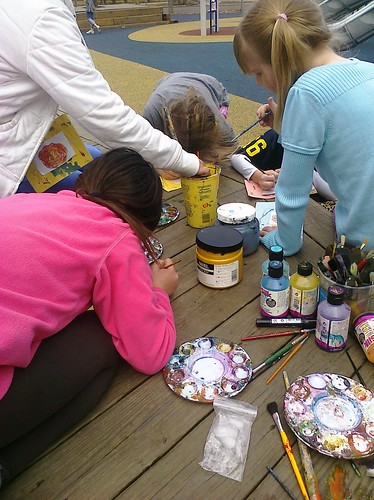
Painting on the Playground
I got the idea to do this from two different sources. I was inspired by the give and take relationship in the Responsive Classroom movement and the Participatory Medicine philosophy of the e-Patient.
When I first began asking children what they would like to create, I was told by many teachers and parents that children needed to be told what to do. I was told that they were not educated enough or that they were too wild and flighty and their ideas would have no merit. It would be better if the teacher and parents just spoke amongst themselves and then just made the children paint.
For many years I went along with this model. I would go in a class and we would do the picture we were told to create. Then I saw the joy of students in a responsive classroom model, and I felt the auction art method must change.
So now I go into a class and we discuss the pros and cons of each project. We talk ROI (Return on Investment) and we speak of history and art while the children decide what they would like to create. It is an amazing process and because the children own the concept they are excited, engaged and empowered. I was honored to help create 20 projects using this method at CCBC Preschool and Murch Elementary this winter and I am overjoyed with the results.
4th grade
Murch of the Now
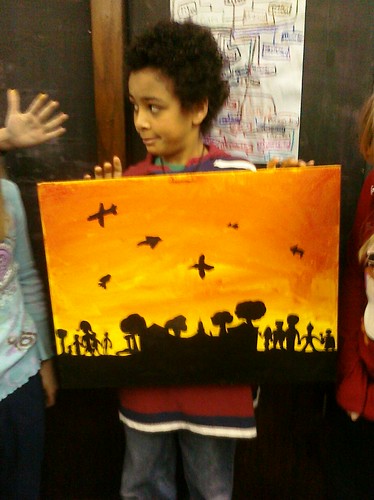
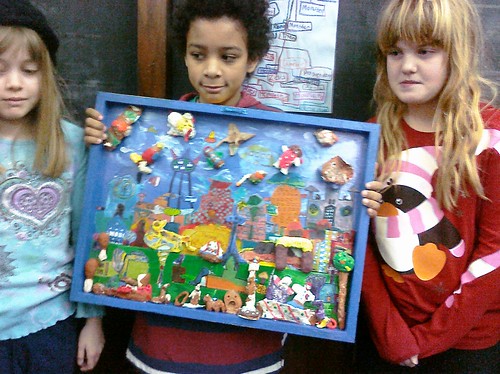
In Asha Mathur’s fourth grade class, the students were brimming with ideas. We had an in depth brain storming session. And the children decided they wanted to do a two-sided piece. On the face side the students created a silhouette of the school with trees and students. It is the “Murch of the Now” and is held within a physical structure of the school. In the shadow box side, the students created their version of “Murch of the Future.” I find the “Murch of the Future” amazing, as it has no physical building that is defined as “school.” Opportunities to learn are everywhere. These 4th graders have grasped a concept that many of the elders do not comprehend. In a cloud-based learning system, the sky is the limit. "Murch of the Future" 18X24 4th Grade Class
While creating this sparkling future vision, one child piped up with a question. “If we are creating a picture of the future should we be painting trash and pollution?” I responded, “It is your choice. You can create a sparking future or one filled with waste. You are the young. You are the future. And the painting you create will help define the future that you live in.”
While saying those words, I went over to the chalkboard. I began to draw a series of upstroke lines culminating in a puffy rounded-shape. I asked the children what I had drawn, they responded, “A tree!” I said no, “That is a mushroom cloud. And when I was a child that was an image that everyone understood and it was a possible future. But you see a tree, and that is beautiful. That is the future you see.”
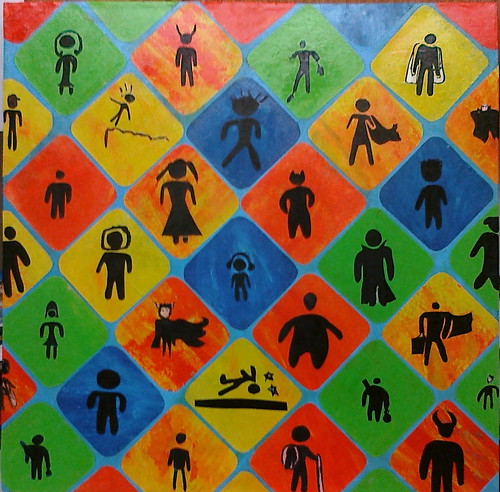
Mr. Paterson’s 4th grade class was inspired to paint image after image of Stickman on their own fantastical safety signs. You know stickman he shows up as a common pictograph human telling you where and when to walk, which floors are slippery and which restroom is the appropriate choice depending on your gender. I was so excited to see their creative uses of such ubiquitous image. Not long after working with these creative students, I had the opportunity to speak with a QIO (Quality Improvement Organization) and the CEO's at a hospital. I told them about the immense power of the simple patient safety sign. The patients are watching, the children are watching. If we place simple images in the corridors of medical institutions, the visual message will be understood and acted upon. Thank you Mr. Patterson’s class for focusing on this important topic in our society.
"Stickman"  24x24 Acrylic
Ms. Finberg’s class had already begun their project of decorating two birdhouses, but I helped them the painting aspect. Children painted a photo of their likeness on two birdhouses created by a Boy-scout troop. It was a wonderful example of re-cycling and using objects in new ways.The Birdhouse Project
3rd Grade
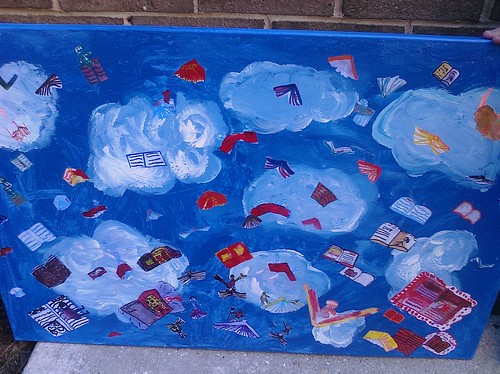
Ms. Hsu class decided to paint about Literature. The Painting “Flying Books” depicted the way your mind can soar when you have the ability to read. The children could focus on a specific character or book within their picture. I was amazed that most students were creating books without titles. They were depicting the power of literature and story to change lives and open minds and knew that topic to be too large to be constrained within one title.Flying Books
Mrs. Friedman’s class seemed exuberant, yet, fractured in their vision when I came to speak with them. They wanted to speak about places and themes of babies and memes. As I poured over the images they captured, I wondered at what they had created. This was not typical auction art. I realized the concept throughout was Internet memes. They were especially focused on the use of baby images throughout viral advertising. I think this piece is one of the most edgy auction art pieces I have seen. These children are thinking. They are making a statement. In their depicting image after image of babies selling products, how can that not be a statement on auction art itself? Hmmm… Thank you for your message. I take it directly to heart. And thank you Orly Friedman, you are teaching children to ask some very important questions.

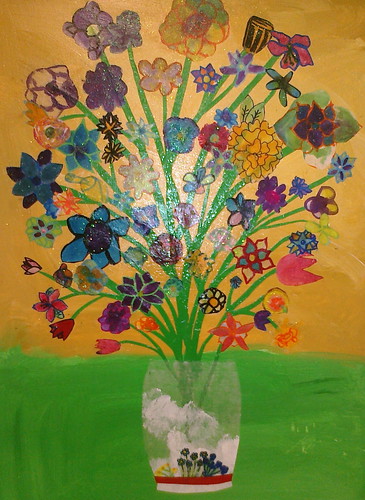
Some students in the third grade classrooms also worked on a teacher appreciation project. They spent the majority of their recess creating a lovely flower vase piece that would become the foundation for a teacher appreciation card later this week. The third graders seemed to be having so much fun that some kindergarten students and fifth graders joined in as well. Flower Vase Project, Murch Third Grade
2nd Grade
Ms. Maravi’s class wanted to create an elaborate and multilayered approach to a forest scene. The students created their own Robert Frost inspired poems. Then they painted birch trees that incorporated the poetry. They also created crawling bugs and flying insects that completed the scene. I love that these piece when seen from a distance, seems so simple. When you are up close the poetry becomes apparent. Recently, I gave a speech about health and decided to close with a poem I had written. Another speaker, came up to me afterwards and told me had inwardly groaned at my words. Not a poem, he thought. He had succumbed to a belief that an original poem by an amateur is painful to listen to and adds nothing to the presentation. He admitted he was wrong. Thank you students in Ms. Maravi’s class you get the power of poetry.

In Ms. Schafer’s class they were concerned about the environment and decided to depict a rain forest scene. The children created brightly painted animals and insects within a forest of the brightest green. It was such a pleasure to work with Ms. Schafer again. She had been my son Freddie’s second grade teacher. She is an amazing advocate for her students. In April of 2009, I had last worked with her. Fred was so sick, and I finished assembling her class project at Fred’s bedside. It was so good to work with her again and to do so with a happier heart
The rainforest piece
1st grade
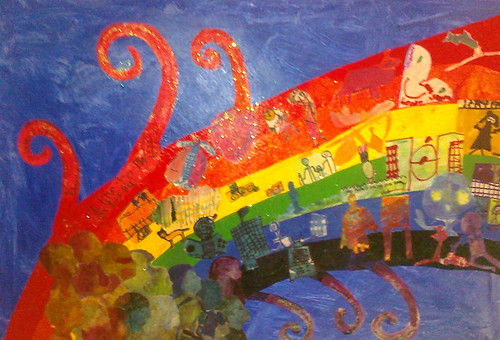
Ms. Werner’s class wanted to work in a variety of mediums and concepts and I came into their process when it was well underway. The wanted silhouettes, quotes, and drawings. We combined all three by creating a rainbow of possibilities. The entire class combined all of these concepts into a free-spirited vision of themselves.
A Rainbow of Possibility Kindergarten
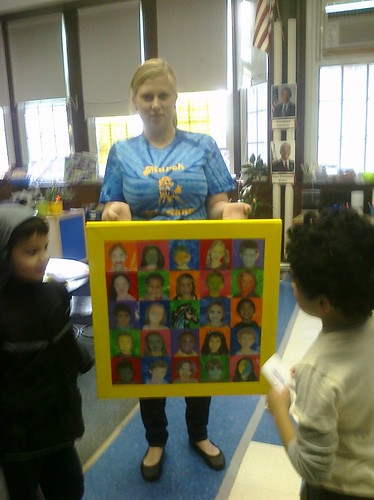
A Warhol portrait piece was the inspiration for the class project of Ms. Bogan’s class. Using the bright colors of the sixties pop art movement, they painted photographic self-portraits. Ms. Bogan's Warhol Piece
Pre-K
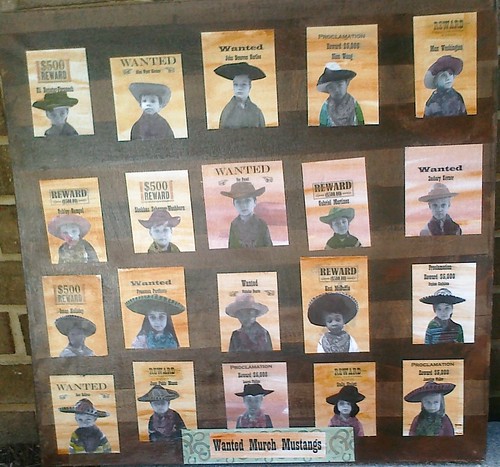
Ms. Emily Stewart’s pre-k class is quite active. My son Isaac is one of the student’s in this class, so he was very excited when I appeared to discuss their auction art. We discussed many options that the class could work on. They could paint a DC landscape or perhaps an underwater fish scene. They decided they would like to paint themselves as cowboys. So, each child created a painted faux tintype. These images were then combined to make a wall covered with old wanted posters. It is a great piece and I would not have thought of it in million years. There is an amazing result that occurs when you are willing to listen to children or patients
."Wanted" 24x24 Acrylic
Later this week, I will go back and work on one more project. In the frantic effort to create the auction art and follow many email threads, one class had been left behind. Murch has a dedicated Autism classroom. The three students in that class had not been asked what they would like to create. On Friday, I went in and asked them. They will be painting a piece about food, animals and music. It should be amazing.
That is the power of art. It can give a chance to use your voice and that is Participatory.