I have always been blessed with a loud and booming voice. As a child I would often get report cards saying, "Regina does not know her outside voice from her inside voice." My husband also received report cards like this. (Our children are doomed.) This statement often confused me as a child. I wondered how the teachers new what I was thinking in my head? I did have a tendency to say whatever I thought. I still have that problem as an adult. I guess now-a-days it would be called filter failure. I once was in business meeting when one of the men at the table said, "Your mouth opens and words just fall out, don't they? My wife is just like you." I don't know if that was a compliment or not....
Anyway, going back to the concept of projection. When I was in third grade, I was cast as the lead in our elementary school musical. I was the Witch in "The Witches Brew." This was a big part with lots of singing. I was so excited I got the part, especially since ... I couldn't sing. What I mean to say is, I could belt out the songs; but had absolutely no sense of pitch or tune. So imagine my joy and surprise at being cast! I loved to sing; I just wasn't any good at it.
A few weeks into rehearsal, I accidently over-heard my music teacher talking to another instructor. She told the other teacher, " Yeah, Regina's singing is horrible! I cast her because she is LOUD. It is more important to be heard, then to be able to sing." I quietly slipped out. It was very hard to go to sleep that night. I wondered if I could go on stage, in front of all those people, knowing I was terrible. I decided to concentrate on the good part. I was loud. I would be very good at being loud.
This is an important lesson to learn in life. We cannot change a lot of what happens to us, but we can choose to always look on the bright side. Even when you are hit by tragedy, you can decide to take on the world and make it a better place. I may not be a good singer. I may not be a very good artist, either. But I am loud.
Sometimes it is more important to be loud. It helps to get the message across. As we say good bye to 2009, I am very glad I was able to use my voice to promote health care reform, patients' rights and data access. And even though I am a terrible singer, I sang briefly on NPR. My music teacher would be so proud.
So next time you think you aren't good enough to add your voice to the public debate, think of me. I was only a retail sales clerk , pre-school art teacher and part-time muralist. When the message is important, God doesn't care if the trumpet is shining and bright. He doesn't even care if it is in tune. He just needs it to be loud.
Saturday, December 19, 2009


Wednesday, December 16, 2009
Giving Thanks in 2009
I remember New Year's Eve Day 2008. I was at the Toy Store. I was finishing up for the day and told Steven, the store manager, that I could not wait for 2009. I said 2008 was so bad it must get better in 2009. Steven just looked at me and said, "2008 was great for you guys. Freddie got to go to Ivy mount and Fred got his dream job at AU." I suppose it seemed from the outside that I was complaining for no reason. But 2008 was very hard.
In 2008, we got the test results for Freddie that said he had high functioning Autism. We had to make a choice to fight for placement in a special ed. Program. In special ed books, they say it is like planning a trip for Paris and ending up in Iceland. Iceland can be a very nice place, but is a shock to give up your plans of Paris. Fred took it very hard. We went to family counseling for 5 months and paid out of pocket as we were not insured for this therapist. He was a wonderful Dr. and cut our bill in half due to need.
We were working constantly and in a tiny apartment in 2008. Fred worked 3 part-time jobs. I worked two part-time jobs and one full time job. Fred and I split the childcare between the two of us. We hardly got to spend any time together. We looked forward to a therapy sessions just because we had 30 minutes to eat lunch on the doctor's stoop before we would meet. It was great. We called it our date. We would eat gas station hot dogs and just talk to each other.
In the summer of 2008 Fred got word he would be hired by American University in the Fall. We were so happy. I went to part time at the toy store and Fred began work in two departments at AU. He was very tired and frustrated a lot of the time. He couldn't understand why it was so hard to do his job and why he had so little energy; but he buckled down and worked hard. Most of his students loved him.
The fall came and went. Freddie missed his old friends from his old school. Isaac seemed to be doing well in his two year old class at CCBC. I juggled childcare and two jobs. Fred finished his first semester at AU. By New Years, I was pretty worn out. I left the store on new Year's Eve and went by CVS and bought a can of Fosters Beer. I thought Fred and I could share it that night.
When I got home Fred said he just wanted to go bed he was too tired. We would celebrate with Fosters some other day when he felt better. And so began 2009....
In January, Fred began to teach again. He his chest hurt. He went to the ER and they said it was cracked ribs from coughing.
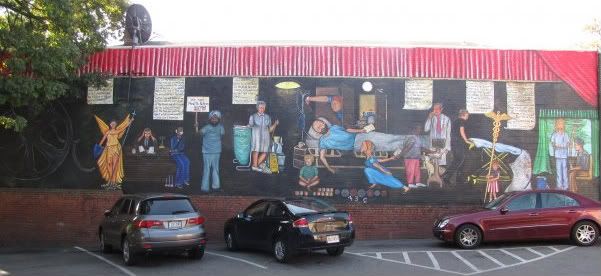
In February, everything got worse. We were all sick with a very bad cold. Our computer was fried by a virus and while we were trying to drop it off at Best Buy our car died in the lot. This was Valentine's Day. Fred and Freddie rode in the Tow truck to The BP station (Where the mural is now). I pushed Isaac in the stroller. It was raining and I was sick with a cough. THe CCBC auction was on the 21st and coughed through drawing 100 children's portraits. Fred was without a home computer so, in pain, he would go each night to his office at AU and respond to email, do Blackboard and Facebook. We began calling February "Cursed February." Fred kept going to his doctor and she kept giving him pain pills.
In March. Our. life. fell. apart. On March 27th we found out Fred had tumors in his kidney and his abdomen, by March 29th we would know they were in his lung's and bones. I would sit in front of a computer screen at 4:00 in the morning researching his disease. They all said the same thing... Fred would only live for a few months with his state of the disease. I read this alone and no doctor would talk to me. No one would tell us truth. On March 31st we celebrated Fred's 39th birthday party.
In April, we would celebrate Easter in Fred's Hospital room. We hid 48 eggs for Isaac and Freddie. Fred watched them find them. On April 19th Fred's oncologist would say he was sending us home on a PCA pump. Fred would tell me to go after them. We transfered to a new hospital. We spend three weeks there.
In May, we would leave the new hospital and go to rehab. This was Fred's last attempt to try to get better. He endured so much pain. He tried to sit while his spine was dissolving. My birthday was May 10. we had a hornet in the room. I ended up killing it. Freddie says it was one of the only good memories of Daddy's cancer care. By late May Fred was failing fast. We would decide to go to hospice. Murch and St. Paul's Lutheran Church would host a rummage sale for us. I would place the first mural.
In June, Fred would be in Hospice until we got into a new two bedroom apartment. W e moved on June 10th and Fred came home on June 11th. When Fred and I were engaged back in 1993, we had a engagement photo taken and had it put in a grand frame. Then we left it at our in-laws house until we had a place nice enough to hang the picture. For the first time it hung in our apartment on June 11th beside Fred's bed. Fred lived for 6 more days and died on June 17th.
There the year stopped. Everything thing that has happened since happened to some one else, because part of me died that day. On June 23rd I began 73 cents.
Since then I have never stopped thinking of Fred. I have never stopped fighting for the rights of people like Fred. We only had less than three month together after March 27th. It is hard enough to be dying. We should not have suffered so. No one should suffer so.
It has been a very hard year, but I am thankful. I am thankful for my two precious sons who look at me with Fred's Eyes. I am thankful for all the great people who came and helped us in our time of need.
I thank the BP station, Pumpernickels and The American City Dinner for the Walls they gave. I thank Christine Kraft who introduced me to Ted Eytan, Claudio, Susannah Fox, Cindy Throop and Epatient Dave. They have all been stalwart friends. I thank the reporters who came to the Mural and spread the word about how much we need medical records access. I want to thank all the families, students and Staff at Towsen, American University, CCBC, Ivymount and Murch Elementary who helped us so much. Thank you too to all the Folks in Western Maryland who fundraised for us. Thank you to St. Paul's Lutheran in DC and St. John's Lutheran in Accident. Thank you to my primary care Doctor and all the medical personnel who tried to help us.
I want to thank God. For in our darkest hour he stood beside us. The spirit of the Lord uplifted our soul. Never doubt there are miracles. We are living in the miracle.
This New Year's Eve I will open that can of Fosters that still is sits in our Fridge. I will toast Fred and 2010. i miss him. I love him. The world will never forget him. He was a good and kind man. He deserved better, as do we all.

In 2008, we got the test results for Freddie that said he had high functioning Autism. We had to make a choice to fight for placement in a special ed. Program. In special ed books, they say it is like planning a trip for Paris and ending up in Iceland. Iceland can be a very nice place, but is a shock to give up your plans of Paris. Fred took it very hard. We went to family counseling for 5 months and paid out of pocket as we were not insured for this therapist. He was a wonderful Dr. and cut our bill in half due to need.
We were working constantly and in a tiny apartment in 2008. Fred worked 3 part-time jobs. I worked two part-time jobs and one full time job. Fred and I split the childcare between the two of us. We hardly got to spend any time together. We looked forward to a therapy sessions just because we had 30 minutes to eat lunch on the doctor's stoop before we would meet. It was great. We called it our date. We would eat gas station hot dogs and just talk to each other.
In the summer of 2008 Fred got word he would be hired by American University in the Fall. We were so happy. I went to part time at the toy store and Fred began work in two departments at AU. He was very tired and frustrated a lot of the time. He couldn't understand why it was so hard to do his job and why he had so little energy; but he buckled down and worked hard. Most of his students loved him.
The fall came and went. Freddie missed his old friends from his old school. Isaac seemed to be doing well in his two year old class at CCBC. I juggled childcare and two jobs. Fred finished his first semester at AU. By New Years, I was pretty worn out. I left the store on new Year's Eve and went by CVS and bought a can of Fosters Beer. I thought Fred and I could share it that night.
When I got home Fred said he just wanted to go bed he was too tired. We would celebrate with Fosters some other day when he felt better. And so began 2009....
In January, Fred began to teach again. He his chest hurt. He went to the ER and they said it was cracked ribs from coughing.
In February, everything got worse. We were all sick with a very bad cold. Our computer was fried by a virus and while we were trying to drop it off at Best Buy our car died in the lot. This was Valentine's Day. Fred and Freddie rode in the Tow truck to The BP station (Where the mural is now). I pushed Isaac in the stroller. It was raining and I was sick with a cough. THe CCBC auction was on the 21st and coughed through drawing 100 children's portraits. Fred was without a home computer so, in pain, he would go each night to his office at AU and respond to email, do Blackboard and Facebook. We began calling February "Cursed February." Fred kept going to his doctor and she kept giving him pain pills.
In March. Our. life. fell. apart. On March 27th we found out Fred had tumors in his kidney and his abdomen, by March 29th we would know they were in his lung's and bones. I would sit in front of a computer screen at 4:00 in the morning researching his disease. They all said the same thing... Fred would only live for a few months with his state of the disease. I read this alone and no doctor would talk to me. No one would tell us truth. On March 31st we celebrated Fred's 39th birthday party.
In April, we would celebrate Easter in Fred's Hospital room. We hid 48 eggs for Isaac and Freddie. Fred watched them find them. On April 19th Fred's oncologist would say he was sending us home on a PCA pump. Fred would tell me to go after them. We transfered to a new hospital. We spend three weeks there.
In May, we would leave the new hospital and go to rehab. This was Fred's last attempt to try to get better. He endured so much pain. He tried to sit while his spine was dissolving. My birthday was May 10. we had a hornet in the room. I ended up killing it. Freddie says it was one of the only good memories of Daddy's cancer care. By late May Fred was failing fast. We would decide to go to hospice. Murch and St. Paul's Lutheran Church would host a rummage sale for us. I would place the first mural.
In June, Fred would be in Hospice until we got into a new two bedroom apartment. W e moved on June 10th and Fred came home on June 11th. When Fred and I were engaged back in 1993, we had a engagement photo taken and had it put in a grand frame. Then we left it at our in-laws house until we had a place nice enough to hang the picture. For the first time it hung in our apartment on June 11th beside Fred's bed. Fred lived for 6 more days and died on June 17th.
There the year stopped. Everything thing that has happened since happened to some one else, because part of me died that day. On June 23rd I began 73 cents.
Since then I have never stopped thinking of Fred. I have never stopped fighting for the rights of people like Fred. We only had less than three month together after March 27th. It is hard enough to be dying. We should not have suffered so. No one should suffer so.
It has been a very hard year, but I am thankful. I am thankful for my two precious sons who look at me with Fred's Eyes. I am thankful for all the great people who came and helped us in our time of need.
I thank the BP station, Pumpernickels and The American City Dinner for the Walls they gave. I thank Christine Kraft who introduced me to Ted Eytan, Claudio, Susannah Fox, Cindy Throop and Epatient Dave. They have all been stalwart friends. I thank the reporters who came to the Mural and spread the word about how much we need medical records access. I want to thank all the families, students and Staff at Towsen, American University, CCBC, Ivymount and Murch Elementary who helped us so much. Thank you too to all the Folks in Western Maryland who fundraised for us. Thank you to St. Paul's Lutheran in DC and St. John's Lutheran in Accident. Thank you to my primary care Doctor and all the medical personnel who tried to help us.
I want to thank God. For in our darkest hour he stood beside us. The spirit of the Lord uplifted our soul. Never doubt there are miracles. We are living in the miracle.
This New Year's Eve I will open that can of Fosters that still is sits in our Fridge. I will toast Fred and 2010. i miss him. I love him. The world will never forget him. He was a good and kind man. He deserved better, as do we all.
Saturday, December 12, 2009
Social Media on the Titanic: RT @Titanic #ICE BURG ahead :(

From the movie Titanic (1997)
Rose: Oh mother, shut up! Don't you understand? The water is freezing and there aren't enough boats. Not enough by half. Half the people on this ship are going to die.
Cal Hockley: Not the better half.
I have been thinking a lot about Titanic these past months. Fred and I loved that film. We saw it three or four times in the theatre. It had everything: art, tragic love, action adventure and amazing special effects. As I worked on the Mural "73 Cents" in August, I thought of Titanic. I was often asked, "Why do we need to fix our health care system when it is the best in the world?" This statement reminded me of Titanic. It was the biggest and best of its time. It was the unsinkable ship. It was was grand and out-fitted with the best that money could buy. Amongst all the fine things on the Titanic, one of the most important things was unfortunately ignored: the wireless telegraph.
Charles R. Pellegrino, who writes as an authority in such diverse topics as entomology, forensic physics, paleogenetics, preliminary design of advanced rocket systems, astrobiology, and marine archaeology, wrote quite a bit on the topic of Titanic. I was intrigued by his depiction of the wireless operators. There were Macaroni operators on Titanic. They were paid to send message to and from the mainland for the well-to-do aboard the Titanic. On Sunday, 14 April 1912 while working on and endless stream of personal messages the Titanic operators were hailed by the wireless operator of the Californian at 23:00 hours. He was trying to warn them of ice floes in the water. Now wireless telegraph was a lot like Twitter: Only 140 characters & broad spectrum communication There were a lot of messages coming in and the Titanic operators were sending messages @Cape Race. This tweet from the Californian @Titanic was really messing with the Tweet meme. So to paraphrase in our modern idiom the Titanic operators tweeted: @Californian Shut up, Shut up, I’m working @Cape Race. So the operator on the Californian soon turned off his wireless and went to bed. In about 10 minutes Titanic struck an ice burg. The Californian was only 4-5 miles away; but without the wireless communication they had no idea that Titanic was sinking. The Titanic wireless operators sent out the QED 35 minutes later and the closest wireless communicating ship was the Carpathia -58 miles away.
My point, you wonder? The massive Hubris of the Titanic was not what killed 1,517 passengers. The real problem was not realizing the importance of the communication technology available at the time. The entire catastrophe could have been avoided, if the wireless operators had sent the ice floe message to the bridge. In all fairness, the real-time wireless connection did end up saving 706 mostly first-class passengers who made it onto the life boats. Ironically, these same passengers had sent all those personal messages that had filled the wireless spectrum. I talk to a lot of people who think Twitter is for mindless chatter, and it can be used for that; but talk to the folks who used it in Iran during the election protests and they will disagree. I speak to people who don't think we need a fully accessible and transferable EMR, and I then think of the nursing home residents who needlessly died after hurricane Katrina for the want of EMR/PHR access.
In closing, I wanted to let you know there is a new hospital to visit in Western Maryland. According to their web page: "The new Western Maryland Regional Medical Center has officially opened our doors to begin providing tri-state area residents with comprehensive health care services in one centralized location on Willowbrook Road in Cumberland. This state-of-the-art facility rises seven stories into the sky, has 275 beds, and covers 585,000 square feet of interior space.
Years in the planning, the new Medical Center was designed with patients in mind. Bright, spacious rooms have plenty of space for family and visitors. Nursing workstations are located just outside patient rooms so nurse can be close by. Free valet parking on weekdays and plenty of additional parking in our 955-space parking garage."
http://www.wmhs.com/index.php?option=com_content&view=article&id=174&Itemid=199
Their site does specify that this State of the Art facility has WIFI, but when I called to ask them about whether this was an EMR hospital. The customer service rep had no idea, nor did medical records personnel. A nurse on the floor finally told me they use mixed paper records and computers. I asked about patient access to their data. I was referred back to medical records, where I was told that for 73 cents a page I could get a copy of my medical records....
@Western Maryland Regional Medical Center #ICE BURG ahead.....
Friday, December 11, 2009
Medicine in the Matrix

"That's part of your problem, you haven't seen enough movies. All of life's riddles are answered in the movies." —Davis (Steve Martin), Grand Canyon, from Frederick Holliday's e-mail signature

Fred taught me how to look at movies: to appreciate them as stories and as commentary on our world. When Jen McCabe asked me design the art on a jacket for her to wear to conferences, I thought of the Matrix and how much it applies to the world of health and health IT.
If you do not work in medicine or have not been touched by medical tragedy or chronic care, you are living in the matrix. You have a regular life where talk of EMR and PHR and HITECH may not mean much of anything. You might not even be aware you currently have to pay to get a copy of your medical record. But those of us who have been touched, know we are trapped within a Data-stream. When a medical tragedy occurs time stops. The matrix goes on and you are no longer part of it. You stand outside. You have fallen through the rabbit hole. Do you want to take the red pill or the blue one? Or like a good epatient to you go http://pillbox.nlm.nih.gov/ and find out what in the world are they asking you to take?
Sunday, November 15, 2009
Thank You Stephen King for Under the Dome
When my husband, Fred, first saw me I was painting. I was painting letters on a theatre drop curtain. My hair hung long within a braid. I was kneeling brush in hand. I did not see him standing in the fly-space looking down upon me. The first time we ever talked, we stood in front of the old soda machine in the Green Room at OSU. As the old machine hummed its refrigerated whine, I sipped Mountain Dew and spoke of Randal Flag. Fred looked at me with golden flecked blue eyes and quoted the Dark Tower back at me. We fell in love talking Stephen King.
We married and never stopped talking. We were always looking forward to each new King book. We moved many times in our 15 years of marriage, but the first thing Fred always did was set up his Stephen King shelf of books. I called it the shrine. He loved to show friends and guests these prized books. He said if there ever was a fire the books would leave with him. Fred’s house had burned down when he was but thirteen years old: fire was never far from his thoughts. He assured me he would save his books. He said he would also make sure I got out okay… afterwards. Even in Labor with our second son, Fred brought me a book to read, and thirty minutes after delivery I was chewing ice chips and reading Cell.
Last spring, early in the year, Fred could talk of naught but King’s upcoming book Under the Dome. He was so excited it would be a November release of a long awaited story. He briefed me on the tale; the concept: a dome was encasing a small town in Maine and tensions trapped within. So Fred would say his back hurt and teach his classes and talk of Steven King. March came, and with it sadness. Fred had no slipped disk or muscle pull. His back hurt because of cancer in his spine. He lay in the hospital heart-sick and imprisoned in a body and a bed. He turned to me and said, “What if I don’t make it till November? I might not get to read Under the Dome.”
Two days after he learned he had metastatic kidney cancer, Fred celebrated his 39th birthday in a hospital bed. With his feeding tray came the hospital cake sparkling with ice and tasting of freezer burn. A friend gave him the comic book version of the Stand. Our youngest son gave him a Dora Balloon. I decided to try to get him the best gift ever. I could not stop his illness or get answers from his doctors. I could not walk for him or take his pain away, but I could try to get a galley copy of Under the Dome.
I emailed Deborah our wonderful book buyer at Child’s Play- the toy-store where I worked. I asked her to please contact Simon and Schuster and see if it were possible to get a copy. She emailed her rep. Charlie and he contacted Tyler Le Bleu the marketing manager at Simon and Schuster. Tyler cleared the release with Stephen King.
The book came on the perfect day. This was the day the oncologist said we could get surgery. With surgery Fred could live two more years! Two more years he would have watch his sons grow older. In the midst of this rejoicing, I leaned over his bed like a princess in a fable and kissing him gave him the book. He was so happy he could not believe it. “I guess I’m really dying,” he said. “I get my make-a-wish.”
Thank God for that book. Fred took it on every radiation transport in the next two weeks. He read some everyday. The man, who could read a Stephen King book in less than 24 hours before he was sick, spent the next three weeks reading Under the Dome. Pinned in MRI machine double-dosed with Adivan, I would scream the words of Stephen King at him above the train roar of the machine. Fred tried to read many books while hospitalized, but he only finished one… Under the Dome. I guess that makes a lot of sense, for it seemed like we living in a bubble-trapped with those who wished to harm us and those who wished to help…and not sure which was which. I remember the one passage I read aloud to Fred. The character Brenda prays to God after losing her husband. “God, this is Brenda. I don’t want him back…well do, but I know You can’t do that. Only give me the strength to bear this, okay? And I wonder if maybe…I don’t know if this is blasphemy or not, probably it is, but I wonder if You could let him talk to me one more time. Maybe let him touch me one more time.” That is when I burst in to tears and said to Fred, “I told you I would read to you but how can I read that?” “It is okay, Reggie,” he said.. I will read myself.” And he did.
The weeks passed by and Fred grew worse. We left the hospital and went to hospice. We moved into a bigger apartment so Fred could go home to home hospice. For the first time in our life Fred would not move his shrine himself. We moved the hospital bed into the room and arrayed his books all around. He came home on June 11th. He said the books looked nice. Each day he grew weaker and had more trouble breathing. The morning of June 17th two of Fred’s friends came over: Jeff and David. I warned them Fred was not too good today. I could not wake him. They came any way. Jeff brought a book- Lisey’s Story for Fred. I laughed and said he already had it. He had everything by Stephen King. And then I showed them Under the Dome, the secret book: Fred’s prized passion… his make-a-wish. Fred breathing was so labored now. Each breath seemed its own private war within his body. I stood beside him caressing his arm and holding the book. Three minutes later Fred died.
I want to Thank you Stephen King for Under the Dome. I want thank Tyler and Charlie and Deborah. You did a great good thing. You helped me show Fred there was nothing I would not do for him. You showed him there are many people who care. You shined a light in our darkness. We finished our love like we started it…talking Stephen King.
We married and never stopped talking. We were always looking forward to each new King book. We moved many times in our 15 years of marriage, but the first thing Fred always did was set up his Stephen King shelf of books. I called it the shrine. He loved to show friends and guests these prized books. He said if there ever was a fire the books would leave with him. Fred’s house had burned down when he was but thirteen years old: fire was never far from his thoughts. He assured me he would save his books. He said he would also make sure I got out okay… afterwards. Even in Labor with our second son, Fred brought me a book to read, and thirty minutes after delivery I was chewing ice chips and reading Cell.
Last spring, early in the year, Fred could talk of naught but King’s upcoming book Under the Dome. He was so excited it would be a November release of a long awaited story. He briefed me on the tale; the concept: a dome was encasing a small town in Maine and tensions trapped within. So Fred would say his back hurt and teach his classes and talk of Steven King. March came, and with it sadness. Fred had no slipped disk or muscle pull. His back hurt because of cancer in his spine. He lay in the hospital heart-sick and imprisoned in a body and a bed. He turned to me and said, “What if I don’t make it till November? I might not get to read Under the Dome.”
Two days after he learned he had metastatic kidney cancer, Fred celebrated his 39th birthday in a hospital bed. With his feeding tray came the hospital cake sparkling with ice and tasting of freezer burn. A friend gave him the comic book version of the Stand. Our youngest son gave him a Dora Balloon. I decided to try to get him the best gift ever. I could not stop his illness or get answers from his doctors. I could not walk for him or take his pain away, but I could try to get a galley copy of Under the Dome.
I emailed Deborah our wonderful book buyer at Child’s Play- the toy-store where I worked. I asked her to please contact Simon and Schuster and see if it were possible to get a copy. She emailed her rep. Charlie and he contacted Tyler Le Bleu the marketing manager at Simon and Schuster. Tyler cleared the release with Stephen King.
The book came on the perfect day. This was the day the oncologist said we could get surgery. With surgery Fred could live two more years! Two more years he would have watch his sons grow older. In the midst of this rejoicing, I leaned over his bed like a princess in a fable and kissing him gave him the book. He was so happy he could not believe it. “I guess I’m really dying,” he said. “I get my make-a-wish.”
Thank God for that book. Fred took it on every radiation transport in the next two weeks. He read some everyday. The man, who could read a Stephen King book in less than 24 hours before he was sick, spent the next three weeks reading Under the Dome. Pinned in MRI machine double-dosed with Adivan, I would scream the words of Stephen King at him above the train roar of the machine. Fred tried to read many books while hospitalized, but he only finished one… Under the Dome. I guess that makes a lot of sense, for it seemed like we living in a bubble-trapped with those who wished to harm us and those who wished to help…and not sure which was which. I remember the one passage I read aloud to Fred. The character Brenda prays to God after losing her husband. “God, this is Brenda. I don’t want him back…well do, but I know You can’t do that. Only give me the strength to bear this, okay? And I wonder if maybe…I don’t know if this is blasphemy or not, probably it is, but I wonder if You could let him talk to me one more time. Maybe let him touch me one more time.” That is when I burst in to tears and said to Fred, “I told you I would read to you but how can I read that?” “It is okay, Reggie,” he said.. I will read myself.” And he did.
The weeks passed by and Fred grew worse. We left the hospital and went to hospice. We moved into a bigger apartment so Fred could go home to home hospice. For the first time in our life Fred would not move his shrine himself. We moved the hospital bed into the room and arrayed his books all around. He came home on June 11th. He said the books looked nice. Each day he grew weaker and had more trouble breathing. The morning of June 17th two of Fred’s friends came over: Jeff and David. I warned them Fred was not too good today. I could not wake him. They came any way. Jeff brought a book- Lisey’s Story for Fred. I laughed and said he already had it. He had everything by Stephen King. And then I showed them Under the Dome, the secret book: Fred’s prized passion… his make-a-wish. Fred breathing was so labored now. Each breath seemed its own private war within his body. I stood beside him caressing his arm and holding the book. Three minutes later Fred died.
I want to Thank you Stephen King for Under the Dome. I want thank Tyler and Charlie and Deborah. You did a great good thing. You helped me show Fred there was nothing I would not do for him. You showed him there are many people who care. You shined a light in our darkness. We finished our love like we started it…talking Stephen King.
Friday, October 23, 2009
Thoughts on Medicine and Social Media
On Wednesday, May 27, 2009 I met Dr. Ted Eytan. I was invited to present a patient and caregiver view of hospitalization at a small health 2.0 meeting. I saw Powerpoint presentations with bar charts and graphs. I sat patiently taking notes about the state of ehealth and social media. At around 3:15 I spoke. I described the horror of my husband being diagnosed with cancer and of terror of not being told what was going on. I spoke about the fight we had fought to get to get a copy of the medical record. I recounted the numerous times I had used the information in his record to improve his care. The record sat upon the table in a three inch thick binder. There was silence in the room. We were no longer speaking in the abstract about patients. They asked me to focus on what was the worst thing that had happened through this entire tragedy. I told them the worst thing we experienced was lack of access to my husband’s data.
While Fred was in Hospice care, I placed the first mural. The Medical Facts mural as a re-visioning of the face sheet mimicking in style and clarity the nutrition facts label: all important, vital statistics are present with norms for comparison. How do you know your blood pressure is high or your hemoglobin low if you do not know what normal is? Where are the bone mets and the soft tissue mets? Where could you harm this patient just by touching him? Fred was injured twice by techs moving his body who had no idea of the extent of his disease. I asked a nurse, “Who reads the medical record?” Her response was “We read the face sheet and maybe the most recent pages.”
Wednesday, October 7, 2009
Small Business and Insurance
For many years I had the pleasure of working at Barstons Child's Play. During my time at the store I worked as an assistant manager and buyer. I was a full-time employee and individual employee health insurance was covered. When my husband and I looked at the rates to pay for my husband and two children on the policy, we knew we could not afford it. We could barely manage rent, student loans and food on our combined salaries. We paid out of pocket for medical care for many years for both my husband and two sons. When Fred was hired at American University, as part of a large insurance pool we could finally afford FAMILY insurance.
Part of my dismay at the way insurance is handled in the US is the fact that small business is asked to shoulder such a heavy burden. There is no way Child's Play -a small mom and pop store, could afford to offer the same low group rate that American University could offer. I made the choice to work at a small specialty store. I really enjoyed working there. I could have probably worked retail for a large corporation and maybe found a affordable family policy. I did not do that. In retrospect, Did my decision kill my husband? I guess it did. But do you want to live in a country where we decide where we work based on what insurance is available to its employees? And in such a country, what would happen to all the Mom and Pop Stores?
There is a reason in "73 cents" the small businessman is holding his head at his desk, late at night with a past due notice in front of him. Small business suffers greatly in this country.
Part of my dismay at the way insurance is handled in the US is the fact that small business is asked to shoulder such a heavy burden. There is no way Child's Play -a small mom and pop store, could afford to offer the same low group rate that American University could offer. I made the choice to work at a small specialty store. I really enjoyed working there. I could have probably worked retail for a large corporation and maybe found a affordable family policy. I did not do that. In retrospect, Did my decision kill my husband? I guess it did. But do you want to live in a country where we decide where we work based on what insurance is available to its employees? And in such a country, what would happen to all the Mom and Pop Stores?
There is a reason in "73 cents" the small businessman is holding his head at his desk, late at night with a past due notice in front of him. Small business suffers greatly in this country.
Subscribe to:
Posts (Atom)